Sunday, February 7, 2010

Guarishankar Round Two (Taryn Falls In Love With Nepal)

Guarishankar Mountain

I was really excited and a little nervous to go back to the Guarishankar orphanage where I did my first placement with Felicia. Excited because I missed the boys and the beautiful setting and delicious authentic Nepali meals. Nervous because although I had been in Nepal for almost four months when I left, I still hadn't gone anywhere without at least one companion who was fluent in English. And because I wasn't sure if my ambitious intention of painting 2 large murals on the walls of one room and painting the inside of the dining room would work out. I really had no idea what I was doing.

On the day I arrived and the next day, my nervousness prevailed. I succeeded in going to buy some paint, guessing how much I would need, but I was having a hard time explaining to Gita, the Auntie, or anyone else what I intended to do with the paint. Uncle Om was in Kathmandu on business for the first couple days, so I couldn't really talk to him. I also discovered that the walls of both the rooms I wanted to paint in were covered with this mysterious chalky white substance that came off a little by scratching or soap and water. I didn't know a lot about painting a wall with enamel but I did know you were supposed to have a clean, dry surface: not one covered in a strange powder. I had no idea how to go about removing it. Also the room I wanted to paint the two main murals in had been turned into a computer room since I left-a donation from a foreigner-and I didn't want to paint near them, especially since the walls were already covered by drawings the boys had made, including several from the classes Felica and I taught so many months ago. Of course by the time I figured all of this out, I had already bought enough paint for a couple large murals. And on top of all that, I didn't have a fellow volunteer to freak out to. I couldn't even take my mind of things by playing with the boys since they were all in school. I was not happy. I took comfort in reminding myself that I didn't take a gap year just to coast for a year, I took it to improve upon myself in ways that I can't while in school and to learn real-world lessons. And there they were, being learnt: nothing is as simple as you plan for it to be.

Luckily things started turning around the next day. Firstly, many of the boys had a day off from school since they were starting exams the following day and I spent the morning and early afternoon playing all sorts of games with them. They were just as excited and curious and funny as the first time. I re-learned the rules of carim, one of the most popular games in Nepal that's like pool but you play with flat plastic discs and try to flick them into one of the four holes. I remembered the rules okay but was just as terrible as when I learned in October. I also played ping pong on two dining room tables pushed together, and my favorite called "Bomb Blast" played with a small ball made from black rubber strips- the goal was to hit other players or catch a ball thrown at you to get each other out. The best part was that if the person who got you out was out, you were back in. So you could only effectively win by getting every single person playing out-the game went on for a long time.

Playing carim

Uncle also came back in the afternoon and approved my new plan to paint the front gate- a place where I wouldn't get in the way and that wasn't covered in white stuff, and proposed some projects to keep me busy after that was done. By the end of the first week I had cleaned the gate and painted a mural of Guarishankar mountain on it, which the orphanage is named after. The paint was strange- very fluid and glossy: difficult to mix and use at first but I eventually got the hang of it and was fairly pleased with the result.

The gate: before

The gate: after

Over the next two weeks one of the brothers(three men who cook, clean, garden and do repairs at the orphanage) named Orco and I, with help from the boys, would fix and paint the slightly crumbling pillars on either side of the gate: fix them with real cement and paint them with white cement. White cement is actually the same mysterious white substance covering most of the walls in the orphanage. It's just a cheap paint substitute and comes off with wire brush scraping followed by water, so painting enamel is possible on the walls after all. We took advantage of this and painted enamel on the bottom half of the dining room, the main room of the main building, and the hallway leading to the boys' rooms so they would look nice and be easier to clean. We painted another white cement coat on the tops of those rooms, and put another coat on all the pillars around the orphanage. We repainted many of the windows and doors in enamel and resurfaced and painted the tables in the dining room. We also re-painted the sign on the roof in enamel that said, in Nepali, "Nepal Children's Organization - Guarishankar Orphanage - Mati/Charikot, Dolokha - Est. 2053 (the Nepali year)."

The last project I did before leaving was to give the artistically-minded boys pencils and paint and brushes and help them design and paint their own pictures on the dining room walls, which was the most fun I think. I was drawing in the dining room with one of the most artistic boys, Pasang, who I hadn't had many conversations with before since he was usually pretty shy and he told me that the orphanage felt different when I was there. I didn't ask how it felt different but I'm pretty sure he meant it in a good way. It made me feel useful.

The roof: before


The boys trying to figure out how to use my camera while I paint on the roof

Orco brother painting on the roof


Completed roof and gate!


Pasang sketching welcome with namaste hands in the dining room


Painting in the dining room- Sitaram's design
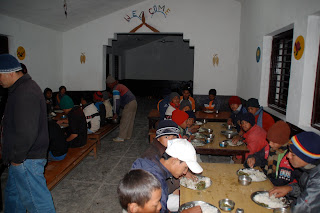


The boys eating dinner with their new designs on the walls


Newly painted main building hallway


Between working I would play carim with the boys (I was actually pretty decent and sometimes even won by the end of the three weeks) or play with Uncle and Auntie's chori, a two year old that had the boys, the brothers, and everyone else wrapped around her little finger. She was quite shy at first, and since uncle's family was away for most of our previous stay I didn't get to know her then. By the end of these three weeks she would actually ask me to hold her sometimes and I obviously couldn't resist.


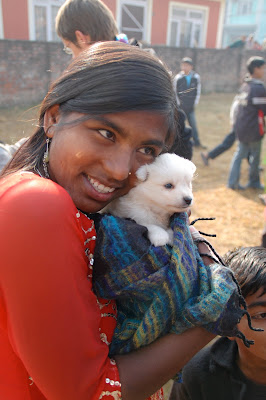
Om and Gita's daughter


Work was also alternated with plentiful cups of fresh milk tea, breakfast and dinners of delicious lentil soup, rice, vegetable curries straight from the garden, spicy pickled ginger or tomato, and the occasional fried egg. Tiffin (lunch) usually consisted of toasted sugared chiura (beaten rice flakes) with spicy snack mix and fried potato. I didn't expect to gain weight in Nepal before I went, but I'm not surprised now that I did. It was too delicious all the time, and they took how much I ate to mean how much I liked it, so I could never say no even if I had wanted to.

Even with all this I still had free time which I filled with copious amounts of reading-I brought six books from the exchange library at the volunteer house and read them all over the three weeks. It was actually nice to have a setting in which I could read so much-with the internet at my fingertips that never happens. It's sort of fun to be able to dive into a book and not resurface until it's finished. My favorite book was The End of Mr. Y By Scarlett Thomas. Truly genius. The reading seemed to make up for the fluent and plentiful English conversation I was so used to. The boys were really sweet and more than one asked me "Are you lonely?" or "Are you Boring?" I had to convince them that no, I wasn't lonely with such wonderful people all around and no, I wasn't bored, I found it rather peaceful and a welcome respite from the pollution and noise and craziness of Kathmandu.

The daily routine was broken up occasionally by a special event: finding and chasing a pack of monkeys through the forest with the boys, watching the lemons be crushed into juice with an ancient Nepali lemon-juicing tool, the first of Mag (5th Nepali month) festival in which we ate a sort of yam and home-made molasses sweets, the festival celebrating the birth of the God of education, which of course meant a day off from school, and two visits by an Italian family.
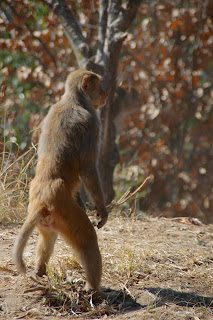

One of a HUGE pack of monkeys


Crushing lemons


The Italian family with their little brother


The Italian couple had adopted two children, a brother and sister, from Guarishankar back when it was first starting, and their little brother still lives at Guarishankar but can't be adopted due to the ban on foreign adoptions in Nepal. It's in the process of being lifted, with many restrictions, but that will probably take years and years. So this couple adopted the brother and sister when they were around ten, and and they're now around eighteen and came back to visit their homeland and their little brother for the first time since they were adopted. They were a really fun family, although they always made fun of my American accent. They spoke about as much English as Uncle, but since Nepali English and Italian English are such different dialects I would sometimes have to translate for them, which was kind of amusing.

When they visited I had to move into the smaller guest room which doubled as a puja room, although I really didn't mind since it often smelled of sweet insense. The regularity with which Auntie prayed everyday, supplemented by fasting, was quite inspiring and comforting in a strange way. Some people just move through the motions of a religion but when she would tell me 'I belive God' her sincerity and good heart were unmistakeable. The only time she wouldn't promptly heed the call of her small daughter was when she was performing puja. She once asked me if I believed in God and when I told her "Sometimes" she laughed quietly.

Gita performing Puja
Although the adopted children of the Italian family and their brother all have different unknown biological fathers, their mother is still alive and in a nearby town to orphanage - but she's not quite right in the mind anymore. Originally the family wasn't going to take the trouble of seeing her since she probably wouldn't even recognize the children and it might cause more troubling feelings than closure, but Uncle and Auntie convinced them it was really their duty as children to visit their mother. In the Hindu culture the obligations of children toward their parents is taken very seriously and in the end they came back to see her. It was a very highly charged, emotional meeting. She was cognizant for the first part and although she didn't recognize them at first she accepted Auntie's explanation of who the children were and that they were being well taken care of. The Italian parents thanked her for bringing the children into the world and she said she was happy that they're taken care of but wished they would visit her more, and Auntie and Uncle had a hard time explaining that they didn't have the resources to come from Italy very often. She saw their nice clothes and didn't understand why they couldn't visit. And then she started talking without making any sense and Uncle and Auntie gave her some food and money and sent her back home. Everyone was crying a little bit.


I set a day to leave, after all the projects were completed, but when the night before my departure date arrived I couldn't bear to leave and postponed it for a day. Om and Gita didn't seem to mind at all, they just said I should keep postponing my departure for a day forever. Over my whole stay the were so incredibly hospitable, always sharing anything they had and making sure I didn't need anything. And Gita would make sure I didn't do anything harmful to myself. They have a superstition that if you sit on something cold you're prone to get diarrhea. So one day I was sitting on the concrete with my legs hanging over the edge and Gita said "Don't sit there." and I said "Why, because it's cold?" and she said "Yes, you'll catch diarrhea" and Om said "You won't catch diarrhea, diarrhea will catch you!" Gita and I didn't stop laughing for a good five minutes. One day Gita made me a gooey, slimy soup from a thistle-like thorny weed. Rumor has it that if you drink one bowl every day you will have a very strong heart. It actually wasn't nearly as bad as it sounds and I sort of liked it, but it took much time and enthusiasm to convince her of that fact.


The day before I left the three brothers gave me a huge bag a goondrook-a sort of plant-spice that is the basis for the national curry of Nepal. They grew the leaves in the garden and then put them through the process to make the goondrook-first they dry it for a few days, then they soak it in water and beat it with sticks, then they compress the leaves in a pot for a few more days and dry them once more before using them in the soup-curry. They also gave me spoken recipes for many of the dishes they had cooked. It was the best gift-I was really touched.

Krishna and Gokul beating the goondrook

Even though the boys were mostly in school this time around, and so not quite as available for conversations and games, I still got to know each of them as individuals better than I had the first time, and I've never met a group of kids with a better sense of humor or who ask for less or who are more curious and open than these boys. It's really a magical gem of a place and I'm so so happy that I chanced upon it.

Keshab and Shamu, with Tenji's hand

Kal and Suraj

Uncle Om and Auntie Gita

The older boys singing a Nepali song at the farewell song/dance/speeches program


On the morning of my departure I was presented with two little wooden Buddha carvings. Although they're mostly Hindu at Guarishankar, a couple boys are Buddhist and they all take pride in Buddha being "The light of Asia." One was from Suraj and Kal, two boys I was close to, and one was from all the others. Uncle and Auntie presented it and said "Taryn, we love you. Don't forget us." Really, how could I? I started tearing. It was so difficult to leave. A couple boys went to walk with me to the bus, and the rest all waved goodbye at the gate. Birjung was among the ones walking with me and on the way he gave me a good-bye present of his own- one of the little glass boxes with two fuzzy chicks and a flower and a heart that I often saw on the dashboards of the over-decorated buses, with a note and a drawing from him on the wrapping paper. I opened it as the bus was driving away down the bumpy winding road to Kathmandu and with the image of everyone waving good-bye in my head, my heart felt so full it physically hurt. Nothing is as simple as you plan for it to be. Sometimes it's better.


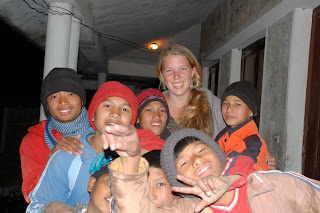
Group Photo

Saturday, December 26, 2009

Christmas at Papa's House, Maoists Making Trouble, and the Ashram

            This post is about the two weeks I spent in Kathmandu after going trekking and before returning to the Guarishankar orphange. 
             When I was first looking at the Volunteer Nepal website, before I had even decided to come to Nepal, I saw one of the Volunteer Opportunities was for the old people's home, and I thought 'Nope, that's not for me.' Cleaning up after old people doesn't sound very appealing. It's not like teaching where you can supposedly change the whole life of someone- their lives have mostly already happened. And there's the added subconcious fear of oh my God, this is what it's like to get old. This might happen to me one day. But I actually found it to be some of the most rewarding work I've done in Nepal. The home is an old Hindu temple that's been converted into housing for old people who aren't capable of taking care of themselves and have nowhere else to go. In Western countries there's an idea that when you're old, you're still mostly responsible for supporting yourself. It's called saving for retirement. In Nepal, most people don't have that luxury. They instead function by the system that sons, especially the first born son, is responsible for feeding and clothing and housing his parents as they age. When a Nepali person grows old and doesn't have a son or is abandoned by their sons, they have no backup plan and end up at the ashram. There are well over 100 people living there, but I worked only in the section specifically for disabled people with maybe 30.
            The change I might have been making in caring for these people was much more tangible than anywhere else I'd been in Nepal so far- The floors and beds and dishes were getting cleaned better and more often, more laundry could be done, and their lives could be made generally more comfortable and sanitary. One day I fed an old woman her breakfast, spoonful by spoonful, because she has a joint-muscular disease that renders her hands practically useless. The most fascinating part about that was the fact that this particular disability was one of the more commonly treated disabilities at the HRDC Hospital in Banepa where I had volunteered earlier. It was so crazy to see where the children being treated in Banepa would end up if HRDC didn't exist.
            I didn't volunteer many days there on account of a having a common cold back to back with three days of a Maoist strike during which it was impossible to get to the Ashram, but it made a distinct impression. The people were so fixed in their ways and would show the same gestures and make the same noises everyday. Many were religious, like the man who was writing in the notebook in the picture above-I asked him what he was writing and he said "Ram" meaning "God" in Nepali, over and over and over again. He had almost filled the pages of this notebook, front and back, and wrote with such slow and deliberate gestures. I just sat and watched him for maybe half an hour after the work was done.
             I spent Christmas at the Papa's House orphanages, and I was amazed to have such a wonderful Christmas in a country whose Christian population is probably 1%. Luckily Nepali people, having so many people of both the Buddhist and Hindu faiths, have adopted the custom of celebrating all the festivals of pretty much every religion, including Christmas for which they had a holiday from school. Their weekends are only one day, Saturday, but they more than make up for it in the amount of school they miss for 'festivals'. And Papa's House celebrated Christmas in style. The highlight of the presents was a new puppy, named Lucky, as a companion for the dog they got on Christmas last year (Snowball). All of the 140 children also got a new blanket, a yellow and black track suit that says PAPA'S HOUSE on the back, and various other clothes and toys and candies. The children were so happy and excited. They also did a secret santa gift exchange among themselves, where each child gave another child a small present and card which was very adorable. 
             The best part of Christmas Day, I think, was the talent show which involved lots of Hindi/Nepali style dances and songs, some gymnastics/breakdancing, an attempt at the Macarena, and a very touching skit on a Kamlari girl being rescued (when parents sell their child as a household slave because they have no money, which is how many girls came to be at Papa's House) It wasn't at all like Christmas at home, but it was still a wonderful day.
           While in Kathmandu I also got to witness a Maoist strike. For three days the entire city shut down. The shops were all shuttered, there were no cars or buses or taxis or tuk tuks on any of the roads, if people tried to ride bicycles they were stopped by the maoists at checkpoints and made to dismount. The schools were all closed as well-the entire country was dead. I've heard all sorts of rumors as to why they were striking, and I think the closest answer is they dismissed the general when they were still part of the government and left it over a dispute about their power to do that. The president has reappointed that general so the maoists are enforcing strikes until the government will listen to them and put someone who will let their insurgents be a part of the army in the position of general. I'm not even sure if that's right though. Of course it doesn't really work and actually is worse for the farmers and street vendors and the lower class that the maoists supposedly fight for than it is for the rich people or the people in power. On the third day I went with Sam, another volunteer to find where the head of the maoist party in Nepal, Prachanda was supposedly speaking. We ended up following a march, pictured, down the road for several miles but missed the formal speech. I wish I understood what they were chanting and the banners they were waving, but I'm not quite that good at Nepali yet.
           Nepal, as a country, usually conducts its day to day business quite normally and I often forget I'm in a country that just had its first free elections two years ago and still doesn't have a formal constitution. It's exciting but also frustrating because a lot of groups, like the Maoists, seem to only be working for power for themselves and the government as a whole is still hugely corrupt. Even with all the foreign aid in Nepal, the workers at the main government-funded orphanage haven't been paid in nine months. The very few garbage collectors in the city are on strike because they aren't being paid either. Bribes are accepted in every governmental department and it seems as if nothing is getting done. It's easy to see why the Maoists and others are frustrated, but I think the Maoist strategy isn't really the way to fix the problem at all. It's all very confusing and makes me so thankful for the system of government in America. I'll complain about the inefficiency of congress a lot less now that I've lived in Nepal.
             After those two crazy weeks I went back to Guarishankar Orphanage, my first placement, for three weeks to do some painting. It was beyond amazing, again, but I'll save that for the next post.

Wednesday, December 16, 2009

You've Never Seen Mountains Like This Before

I wasn't going to go trekking. Really, I wasn't. The question came up fairly often in my first 3 months in Nepal, since that's sort of what foreigners are supposed to do in Nepal. But I was convinced I was just here to volunteer. Trekking was something that didn't need to happen. I'm so glad I changed my mind.
I ended up realizing that for someone who loves mountains and hiking as much as I do, it would be kind of ridiculous to come to Nepal (halfway around the world) for 5 months, and not go trekking once-in the country rumored to have the best trekking in the world. (By the way, the words 'hiking' and 'backpacking' aren't really used in Nepal for some reason, it's all about 'trekking', I don't know why.) So when my roommate at Banepa, Rima, decided to go trekking for one week in the Annapurna area with another Volunteer Nepal volunteer, Patty, I decided to sacrifice a good chunk of my dwindling spending money and join them. Before we left Rima said to me, "You may think you've seen mountains, but trust me, you haven't seen them yet." And she was right.
It's quite a difficult task to imagine mountains more dramatic than the Himilayas. They rise out of the calm and rolling hills as mounds of rock and snow aching to touch the sky, not caring what rules of physics they're breaking. Even when they are so close and in your face, they're practically untouchable save for intense mountaineers like Rima who's going to climb Everest one day.

There's something inherently nice about walking and climbing up and down hills for hours every day. It sort of feels like how humans are supposed to operate: physical exercise, fresh air and all that. And when the reward for straining yourself to get over a hill is spectacular views of the Himilayas, it just becomes that much more wonderful.

The most amusing thing we saw while trekking, aside from the plethera of signs written in Nepali English (see picture below for an example), and aside from when Rima stepped off a cliff to be caught by vines (which was most amusing after she was on solid ground again) was the lodge we stayed at that had an open doorway between the toilet and a storage room. So it happened that a HUGE open basket of potatoes sat RIGHT NEXT to the squatter toilet. Thankfully we saw it before we ordered our food, so we knew not to order the potatoes and it was funny rather than revolting. Also rather amusing was the time when we realized that 4 days into the trek, none of us knew our assistant guide's name, and it was too late to ask. This became rather obvious when Patty tried to say that a cup of tea was his cup of tea and paused where his name should go. We all broke into awkward laughter. Our guides asked bewilderedly why we were laughing and Patty saved the day by talking about how much she loves to laugh and all the other times she also laughed. One of the wittier topic diversions I've witnessed...


So did I accomplish much in service to the Nepalese while trekking? Excepting employing a couple guides and bringing more business to some trekking lodges not really, no. But I learned how to play Rummy 500 and saw views of mountains that made my heart hurt from an overload of beauty and now I can spend the 6 weeks I have left in Nepal (Only 6, can you believe it?) doing the last two volunteer projects I wanted to do. I'll work at the old age ashram (as much as I can between the Maoist transportation strikes) and Papa's House Orphanages through Christmas and then go back to Guarishankar orphanage for a while to paint 3 murals I've planned. And then home! The end is in sight for the first time since I came, and it's a strange feeling.

Sunday, December 13, 2009

Thoughts on Tourism in Nepal

The concept of tourism is a strange one. Tourists go to a different country for new experiences but, at least in Nepal, the majority of them only seem to do what tourists are supposed to do. They take a flight over the Himalayas and go paragliding in Pokhara and ride on an elephant in Chitwan and go bungee jumping in a canyon and they walk around the tourist district and buy felt crafts and hemp shirts and other things that no local Nepali people would buy, ever. They see something different than their home countries but also something that doesn't have a lot to do with Nepal. Tourists seem to live in their own bubble-culture.
There's nothing wrong with tourists- they support the economy of a country that needs it and they do experience new things, but sometimes they seem to skim over the character of a country and try to fit it neatly into a pretty image. They're not always fully aware of the things around them. Nepal isn't really captured by nice kukuri knives and prayer flags and pashmina scarves and clean cafes that serve "Nepali tea". When the average tourist goes home and tells their family and friends how they've fallen in love with Nepal, they're just kidding themselves. Real Nepal with its living standards, complete lack of women's rights, caste system, arranged marriages, maoist violence, and trash and pollution problems is much harder to fall in love with than sunrises on snowy mountain peaks and pretty temples and comparatively cheap prices. It's still possible to love Nepal with all of its flaws, it's just much more difficult. And it takes lots of time and experiences with the local Nepali people to learn how.
I haven't come to like or accept the problems of Nepal I mentioned, but I've come to love the landscape in all its diversity and the noisy, colorful, crowded and dangerous buses and the natural goodness displayed by a vast majority of the people and the dhal baat twice a day and the flow of the traditional kurta sural and most of all the determination and hopefulness of the people even when the odds are all stacked against them. I love Nepal even as an average local experiences it, cold showers and all. And in that way I think I can mean it when I say I'm in love with Nepal, because I recognize its flaws in their entirety and feel them outweighed by its strengths.

Saturday, December 12, 2009

Banepa: Crayons and X-rays at HRDC

On my first day working at HRDC, Hospital for the Rehabilitation of Disabled Children, I almost vomited and then I almost fainted. I had just finished helping with the plaster casting of 3 children with clubfoot, a genetic disease where the foot twists inwards. The technicians at HRDC cast their feet in plaster of paris, move their foot into a more normal alignment and let it set. The casts are left on for a little under a week, and the children get six to ten, or sometimes more casts. The children who are older or who have particularly bad cases also need surgery after the casting, but for many of the infants, casting and special shoes can completely cure their condition. The downside is it can be pretty painful while the cast is being put on...changing the alignment of bones and muscles isn't particularly comfortable. So when, after helping cast a kid who screamed particularly loudly, I felt myself get light headed. I became pale and sweaty and cold and very  nauseated. Luckily after that little episode I was fine helping with castings and did many many more over my three and a half weeks at HRDC. 
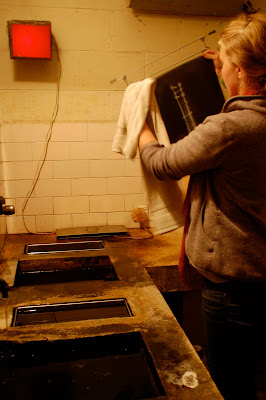
At first it was difficult to figure out what I was supposed to be doing, or what I could really help with, but after the first week or so I fell into a pattern. In the morning before tea I would help with the castings. Between tea and lunch I would give the kids who wanted them crayons and paper and try to facilitate a peaceful coloring time. It was much more difficult than you would think. By the end of my time I had overseen the coloring of about 400 different pictures, back and front - enough to line the walls of the ward and make it a little less hospital-depressing and a little more colorful. Then after lunch I would usually help out in the x-ray dark room. Yes, they do still manually develop x-rays in some hospitals in the world. After I learned to develop them on my own, I could actually help the waiting time in the x-ray department when it was busy. On my last day the x-ray technician even let me develop an x-ray of my own hand! Probably the coolest souvenir  I'll get from Nepal. 
Besides having the hospital placement, Banepa was great for day trips. I went to Bhaktapur twice, an old-style Nepali city just a 20 minute bus ride away. There was a little cafe overlooking the smaller square where I would order a huge pot of milk tea and sit and read. It was a little touristy, but there were some great old statues and temples and carvings. Once I spent a while walking around outside of the Bhaktapur square areas - a very stark contrast to the squares themselves. It was one of the poorer, dirtier neighborhoods I've seen, with people still living in the crumbling houses that were built in the 17th century and garbage everywhere. It made me sort of upset to see such poor standards of living right next to, even in, such beautiful things and none of the other tourists were seeming to notice. No one else ventured outside the pretty, clean squares.
I also went to Naugurkot with my roommate Chanty, a city a short bus ride away, with some nice views of the mountains. It was cloudy when we arrived so we couldn't see mountains from our hotel (The Hotel at the End of the Universe) but the sunrise was very nice. It was nicer when I didn't have trekking sunrises to compare it to, but still a good sunrise. For other day trips I went with Rima, my second roommate at Banepa, to a HUGE statue of Shiva an Indian man is building for an upcoming Hindu festival. We didn't really realize you could walk up a nice road to get to the statue, so we cut across a steep grassy hill and became covered in burs, came across a Nepali couple in the trees being intimate, and finally made it to the Shiva where we ate pringles and enjoyed a view of the valley.
Between all the day trips via crowded buses, I was pretty practiced at riding on the tops of buses by the end.  
 On one of our last days at the hospital, we walked with four other HRDC volunteers up the hill behind the hospital and had a nice picnic at the top. At HRDC a lot of the other volunteers came from Volunteer Abroad...there were volunteers from Holland, Finland, Germany, Australia, the U.K. and America while I was there. The community of other volunteers was very nice and we had some interesting discussions over morning tea.
Also while in Banepa Chanty and I set up a fund for a kid at HRDC who was paralyzed from the waist down due to a tumor in his spine. HRDC is a free hospital and they were able to surgically remove the tumor, but they don't have the facilities or medicines to treat cancer and this kid didn't have the resources to get the chemotherapy necessary for his cancer. He was going to be discharged from HRDC to go home and battle cancer on his own, so Chanty and I decided to raise money to get him admitted to the cancer hospital. Our friend and family really came together and helped us raise over 1,000 USD, but it turns out that raising money was the easy part. The cancer hospital was in Kathmandu so we had to go back and forth from Banepa to get him admitted (which took 3 days) and pay for the tests and the chemotherapy he got, and make sure he and his father were taken care of and getting the right treatment and everything. With the way Nepali hospitals are run, this wasn't an easy task. We finally got his first round of chemo done and sent him and his father home for three weeks until the next round, and entrusted the money for the rest of his treatment to Damu, the HRDC doctor who's house we stayed at and who is a wonderfully nice person. It was such a headache sometimes, but I'm so glad we were eventually able to help this kid and his family, and it made me really appreciate what families with sick or disabled children have to go through in Nepal to get their children treated.
HRDC was overall a really fun placement. The food was delicious, especially the breakfast of chipatti bread, bananas, jam, boiled eggs or potato curries and lots and lots of milk tea. Except the one festival day we were served a sort of molasses wrapped in dough that was not so pleasant. The rooms were comfortable and occasionally we even had a hot shower (!)
In Banepa there was a free community yoga class that I went to twice during my stay. It was at 5:30 in the morning, but totally worth it. It was a decent workout, some nice stretching, but the best part was at the end when the whole room of almost all local Nepalis did the laughing exercise - throwing their hands back over their heads they would laugh the most loud and unnatural laugh, then reach down to touch their toes and repeat the process ten times. I would laugh too, but not really as part of the exercise.
Rima and I were at the HRDC placement for Thanksgiving, so we came back to Kathmandu to try to get the other American volunteers from Volunteer Nepal together and go to a place in Thamel that was rumored to serve a real Thanksgiving dinner. Unfortunately the plans fell apart for one reason or another and we found ourselves at the restaurant by ourselves. Amazingly, at the table next to us was an American couple we both knew, so we ended up having a pretty festive dinner. The meal was delicious and pretty complete - everything except for the cranberry sauce. The restaurant owner came by and invited us to go back to the kitchen for seconds (or thirds in my case..) We were all in a proper Thanksgiving food coma by the end.
Saying goodbye wasn't easy, but HRDC is a well-run hospital with plenty of staff and plenty of volunteers and a little too much down time, so I felt I could be more useful elsewhere. I'm starting a placement where I change beds and wash dishes and clothes at the old age home in Kathmandu. It'll be nice to do something hands-on that really needs doing.